
Brakes, tyres and suspension
New Tyres Supplied and Fitted
We supply, fit and balance new tyres at our Moorooka workshop and check the alignment while the car is here, because a new set fitted to a car with the angles out will be worn on one edge before you have finished paying for it. Tell us how and where you actually drive and we will match the tyre to that.
Tyre sizing
How to read your tyre size
The size is moulded into the sidewall and looks something like 225/45R17 94W. It reads left to right. 225 is the section width in millimetres. 45 is the aspect ratio, meaning the sidewall height is 45 per cent of the width. R means radial construction. 17 is the rim diameter in inches. 94 is the load index, which converts to a maximum weight per tyre. W is the speed rating.
The load index and speed rating are not decoration. Dropping below the placard rating is both unsafe and a defect. Your placard, normally in the driver's door jamb, lists the correct size and the correct pressures for your vehicle.
You will also find a four digit date code in an oval on the sidewall. 2319 means the twenty third week of 2019. Rubber ages whether you drive on it or not, and a tyre well past six or seven years old is worth a look regardless of how much tread is left.
When to replace
When tyres need replacing
Queensland's legal minimum tread depth is 1.5mm across the tread face. Below that the vehicle is unroadworthy and the tyre is a fail item on a safety certificate.
Here is the part that matters more. Wet weather grip drops away well before 1.5mm. Tread grooves exist to move water out from under the contact patch, and as they get shallower they move less water. By about 3mm, braking distances in the wet are noticeably longer and the speed at which a tyre will aquaplane through standing water has dropped a long way. Brisbane gets serious rain. Treat 1.5mm as the legal floor and around 3mm as the point to start shopping.
Tread is not the only reason to replace. Cracking in the grooves or sidewall from age and UV, bulges or lumps in the sidewall from a pothole or kerb hit, cupping and scalloping across the tread, and uneven wear from alignment or worn suspension all shorten a tyre's useful life.
Choosing the right tyre
There is no single best tyre
There is a best tyre for what you do. If you are commuting on sealed roads and doing school runs, a quiet touring tyre with a good wet rating and long tread life is the sensible buy. If you tow, carry weight or run a commercial vehicle, you want the load rating and construction to match that load rather than the cheapest thing in the size. If your four wheel drive genuinely leaves the bitumen, an all terrain makes sense, and if it never does, an all terrain just means more road noise and worse fuel economy for no benefit.
Budget matters and we work with it. What we will not do is fit something rated below your placard to hit a price.
How many to replace
Replace two or four?
Four is ideal, especially on all wheel drive vehicles, where mismatched rolling diameters can load up the centre differential or transfer case.
If you are replacing two, they go on the rear. That is counterintuitive to a lot of people, but the better tyres belong on the back so the rear stays planted. A car that loses rear grip in the wet spins. A car that loses front grip understeers, which is far easier to catch.
After fitting
Fitting, balancing and alignment
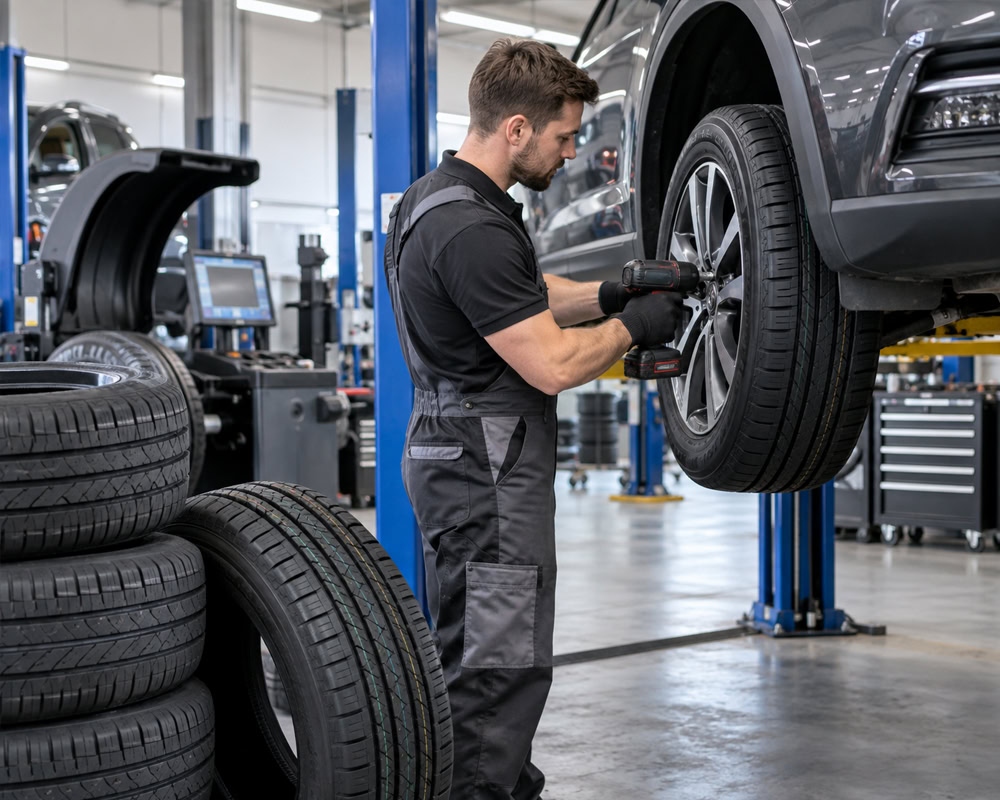
New tyres are mounted, balanced, and the wheels torqued to the manufacturer's specification. Pressure monitoring sensors are handled where fitted, and new valve stems go in on rubber valves.
Then the alignment. If the old tyres came off with the inside edge chewed out, the angles were wrong. Fitting a fresh set to the same wrong angles produces exactly the same wear pattern.
About wheel alignmentPricing
Tyre pricing
Tyre pricing depends on the size, the brand and the type. [CONFIRM: typical price range]
Give us your size and how you drive and we will come back with real options rather than one take it or leave it figure. We take all major cards and cash.
Common questions
Frequently asked questions
What is the legal tyre tread depth in Queensland?
1.5mm across the tread face. Wet grip drops off well before that, so replacing nearer 3mm is the safer call.
Where do I find my tyre size?
On the sidewall of your current tyres and on the placard in the driver's door jamb. The placard is the authority because it lists what the vehicle was designed for.
Should I replace all four tyres at once?
Ideally yes, and on all wheel drive vehicles it is close to mandatory. If you are only doing two, the new pair goes on the rear.
Do tyres expire?
They age. The four digit date code on the sidewall gives the week and year of manufacture. Rubber hardens and cracks over time even on a car that barely gets driven.
Do I need a wheel alignment with new tyres?
Get it checked. If the alignment is out, your new tyres will wear unevenly and you will be buying again far too soon.
Can I fit a different size to what is on the placard?
Only within the limits allowed for your vehicle, and never below the load or speed rating. Get it wrong and the car can be defected.
Can you fit tyres I bought online?
Yes. We will still check that the size and rating suit the vehicle before fitting them.
What causes wear on just the inside edge?
Usually camber or toe out of specification, sometimes worn suspension bushes or ball joints letting the geometry move.
Do you fit tyres to four wheel drives and vans?
Yes, along with European, diesel, fleet, commercial, hybrid and electric vehicles.
How long does fitting a set take?
Usually a couple of hours with balancing and an alignment. Book it in and you can often wait.
Get a tyre quote
Tell us your size
and how you drive.
Monday to Friday 8am to 5pm, Saturday 8am to 3pm. After-hours key drop available. All major cards and cash.