
Engine and cooling repairs
Timing Belt Replacement in Brisbane
Most timing belts need replacing somewhere between 90,000km and 150,000km, or every six to ten years if the kilometres come up slowly. A belt gives no warning before it breaks, and on an interference engine that failure destroys valves and pistons in the time it takes to blink. Check your logbook for your exact model. Call 0402 723 464.
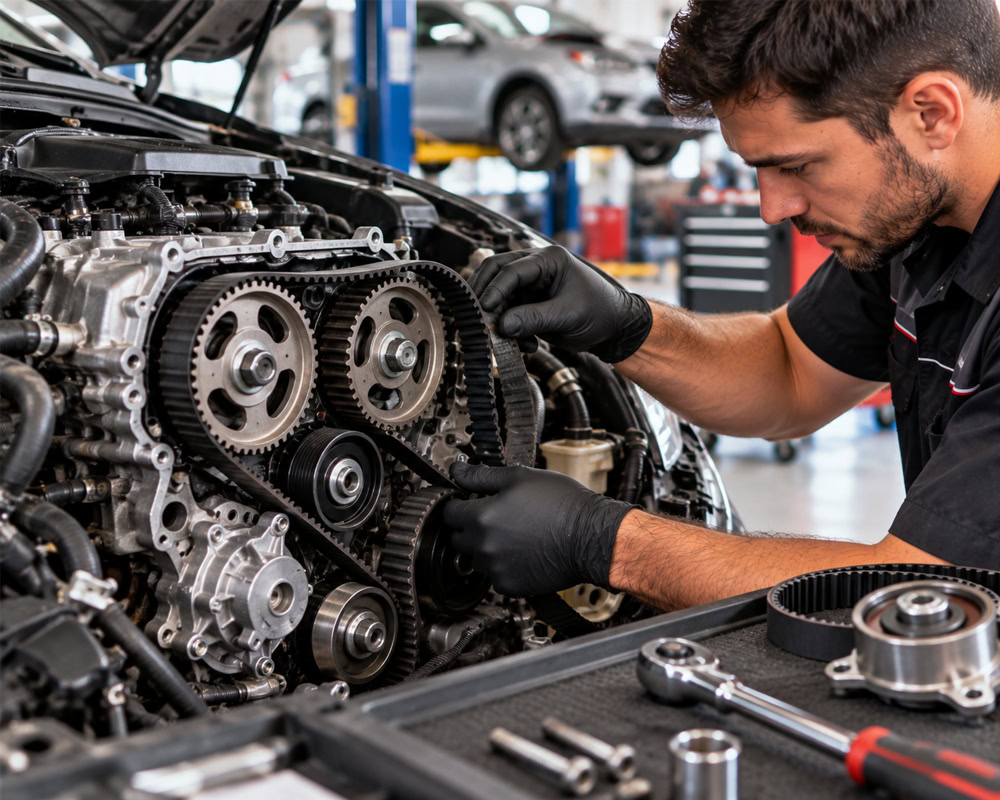
No warning whatsoever
Why this is the one service you do not delay
A timing belt keeps the crankshaft and camshafts turning in step so the valves open and close at the right moment relative to the pistons. It is a rubber toothed belt doing that job thousands of times a minute, in heat, for years.
There is no warning light for a tired timing belt. No noise, no rough running, no warning at all in most cases. It is fine, and then it is in pieces.
The critical difference
Interference versus non-interference engines
Non-interference engine
The pistons cannot physically reach the space the valves occupy, even when the timing is completely out. If the belt snaps, the engine stops. You get it towed, a new belt goes on, and you drive away. Annoying and not cheap, but the engine survives.
Interference engine
The valves and pistons share the same space at different moments, and only correct timing keeps them apart. When the belt breaks, the camshafts stop and the crankshaft keeps spinning under momentum. Pistons slam into open valves. Bent valves, cracked pistons, damaged head — you are looking at a rebuild or a replacement engine.
Most modern engines are interference designs.
Replacement schedules
Typical intervals by make
Your logbook or owner's manual has the figure for your specific car, and it is the one that counts. The time limit matters as much as the distance — rubber ages whether the car moves or not.
| Make | Typical interval range | Notes |
|---|---|---|
| Toyota | 90,000km to 150,000km or 6 to 10 years | Many later engines use a chain instead |
| Honda | 100,000km to 150,000km or 7 to 10 years | Mostly interference |
| Mazda | 90,000km to 120,000km or 6 to 8 years | Later petrol engines largely chain driven |
| Subaru | 100,000km to 150,000km or 8 to 10 years | Belt-driven boxer engines are interference |
| Hyundai and Kia | 90,000km to 150,000km or 6 to 10 years | Varies widely by engine, check the book |
| Mitsubishi | 90,000km to 150,000km or 7 to 10 years | Diesel intervals often shorter |
| Volkswagen and Audi | 100,000km to 150,000km or 6 to 10 years | Diesels and TSI engines differ, model specific |
| Ford | 100,000km to 150,000km or 8 to 10 years | Some engines use a wet belt, different rules |
| Nissan | 90,000km to 150,000km or 7 to 10 years | Many petrol engines chain driven |
| Holden | 90,000km to 150,000km or 6 to 10 years | Depends heavily on the engine fitted |
Why the kit matters
Replace the tensioner and the water pump too
A timing belt on its own is a cheap part. Almost all the cost of the job is the labour to get to it. The tensioner and idler pulleys run on bearings that have done exactly the same kilometres as the belt. A seized tensioner bearing will shred a brand new belt, and then you have paid twice for the same engine damage you were trying to avoid. We fit a full kit rather than a belt alone.
On a lot of engines the water pump is driven by the timing belt and sits right there, already exposed. Replacing it at the same time adds the price of a pump and very little labour. A leaking pump can contaminate and destroy the belt on its way out.
What the job covers
What is included here
- The belt kit with tensioner and idlers
- The water pump where it is belt driven
- A new coolant fill if the pump comes out
- Crank and cam seals inspected while everything is apart
- Timing set to manufacturer specification
- Date and kilometres written into the service record
[CONFIRM: typical price range for this job] — the variation is almost entirely access.
Common questions
Frequently asked questions
How do I know when my timing belt is due?
Check the logbook for your model. As a general range it is 90,000km to 150,000km or six to ten years, whichever comes first.
What happens if a timing belt breaks?
The engine stops instantly. On a non-interference engine you need a tow and a new belt. On an interference engine the valves and pistons collide and you are looking at major engine damage.
Does my car have a belt or a chain?
Many newer engines use a chain, which is designed to last much longer but is not maintenance free. Tell us the make, model and year and we will tell you which you have.
Is there any warning before a belt snaps?
Almost never. That is the whole reason it gets replaced on time rather than on symptoms.
Should I replace the water pump at the same time?
If it is driven by the timing belt, yes. The pump costs little compared with paying the same labour again later.
Can I stretch the interval a bit?
You can, right up until you cannot. The failure is not gradual and it is not repairable by the side of the road.
How long does the job take?
Commonly most of a day. Some engines are quicker, some diesels and V6s take longer.
Does a chain need replacing?
Not on an interval, but chains do stretch and tensioners and guides wear. A rattle for a few seconds on cold start is the warning sign, and it is worth acting on.
Why is the quote different to my mate's car?
Access. The belt itself is a small part of the bill. The engine layout decides the rest.
I bought the car second hand with no history. What now?
Assume it is due. Replacing a belt that had life left in it is a lot cheaper than the alternative.
Book a timing belt replacement
Belt, tensioner and pump.
Done properly, once.
Monday to Friday 8am to 5pm, Saturday 8am to 3pm. After-hours key drop available. All major cards and cash.