
Auto electrical and batteries
Alternator Diagnostics and Repairs
The alternator runs the car once the engine is going and keeps the battery topped up. When it stops doing that, you get a battery light, dimming lights and eventually a car that dies at the lights. We test the whole charging circuit at our Moorooka workshop before replacing anything. Call 0402 723 464.
The tell-tale sign
The symptom that gives it away
If the car starts on a jump lead and then dies once the leads come off, the charging system is the first suspect. The battery had enough left in it to start the engine with help, and nothing is replacing what the engine is using.
Compare that with a battery fault. A tired battery cranks slowly every morning and then behaves perfectly once the engine is running, because the alternator is doing the work. Two very different symptoms, two very different bills.
The dashboard warning
What the battery light really means
The light shows a battery, which sends almost everyone to buy a battery. It is a charging system warning. It illuminates when system voltage is below what the computer expects with the engine running, and the usual reasons are a failed alternator, a broken or slipping drive belt, a failed voltage regulator, or a bad connection.
Treat it as urgent. Once that light comes on, the car is running out of the battery, and modern cars with electric power steering and electric water pumps do not give you long before things start shutting down.
What else to look for
Other symptoms we see
- Headlights that dim at idle and brighten when you rev
- Dash lights flickering, or the interior lights pulsing at traffic lights
- A whine or growl from the front of the engine that rises with revs
- A hot electrical smell, or the smell of a slipping belt
- A battery that keeps going flat despite being new
- Warning lights appearing in groups, which is often low voltage rather than several faults
Full circuit test
How we test a charging system
Charging voltage under load
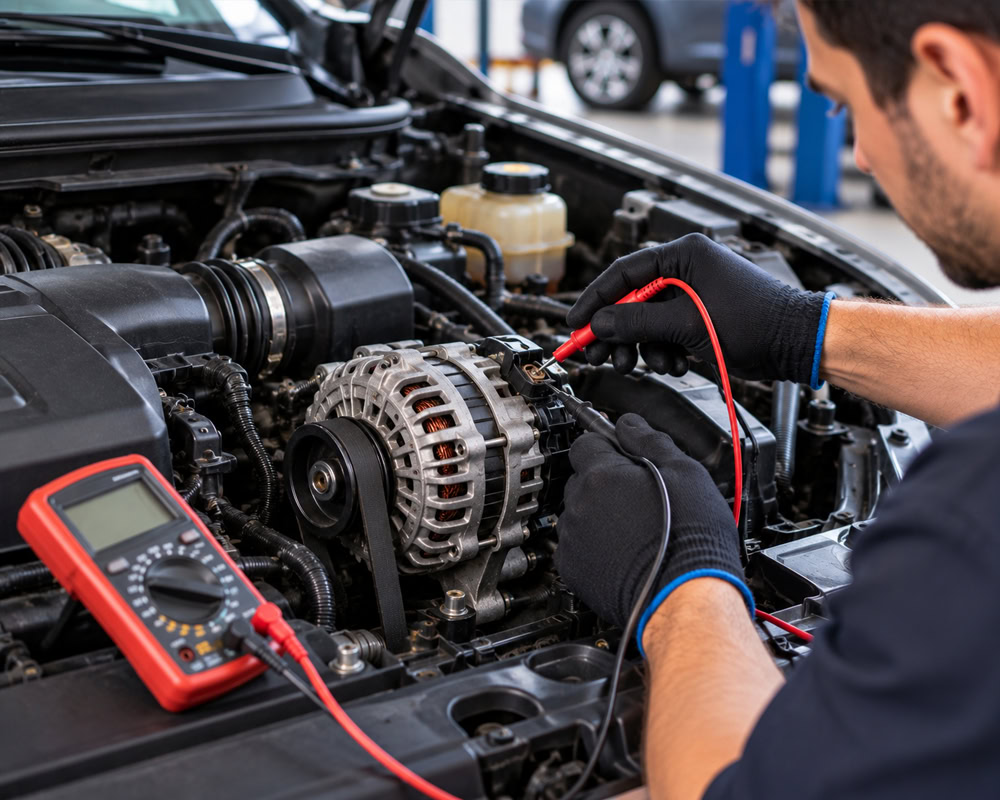
Measured at the battery with the engine running, then again with headlights, blower and rear demister on. Most conventional systems sit in the high 13s to mid 14s. Well over 14.8 is overcharging and will cook the battery.
Ripple and AC output
An alternator that has lost a diode still produces some voltage but pushes AC noise into the system. That shows up as a battery that never quite charges and odd electronic behaviour, and it is invisible unless you look for it.
Voltage drop on cables and earths
The alternator can be perfect and the current still not reach the battery. We measure the loss across the main cable and the earth path under load.
Belt, tensioner and pulley
A glazed belt, a tired tensioner or a seized overrunning pulley all reduce output. Replacing an alternator because of a worn tensioner is an expensive lesson.
Scan tool data on smart systems
Many later vehicles vary charging voltage deliberately, so a reading of 12.7 volts at idle can be entirely normal on a car in fuel-saving mode. Judging those systems with a meter alone leads straight to alternators being replaced for nothing.
The repair decision
Repair or replace
Some alternators are worth repairing. Brushes, a voltage regulator or bearings can often be replaced on units that are built to come apart, which suits older vehicles and some commercial gear.
On most late model cars a quality exchange or new unit is the sensible answer, because the labour to strip and rebuild costs more than the difference and you inherit the rest of the old unit's wear. We will tell you which situation yours falls into and why.
[CONFIRM: typical price range for alternator replacement]
Why both get tested
The battery and alternator relationship
These two damage each other, which is why we never replace one without testing the other.
A dying alternator flattens the battery repeatedly, and a deeply discharged battery loses capacity permanently. Fit a new alternator to that battery and the car is still unreliable. Going the other way, a badly sulphated battery makes the alternator work at full output for long periods, and running an alternator flat out for hours is how the diodes and bearings die early.
Common questions
Frequently asked questions
Can I drive with the battery light on?
Only far enough to get somewhere safe. You are running on stored charge and it will not last long, particularly at night with the lights on.
Is it the battery or the alternator?
Starts on a jump and dies when the leads come off points at charging. Slow cranking every morning that clears once running points at the battery. Testing settles it either way.
How long does an alternator take to replace?
Commonly a couple of hours. Some engines have the alternator buried low or behind other components, and those take considerably longer.
How much is a new alternator?
It varies a lot by vehicle. [CONFIRM: typical price range for alternator replacement] You get a firm quote before any work starts.
Can a bad alternator damage my new battery?
Yes, in both directions. Undercharging leaves it flat and sulphated, overcharging boils it.
My charging voltage reads 12.8 at idle. Is the alternator dead?
Not necessarily. Smart charging systems reduce output on purpose. That reading needs checking with a scan tool rather than a meter alone.
What is that whining noise?
Often an alternator bearing or a failing pulley. It can also be the belt or the tensioner, which is why the belt drive gets inspected as part of the test.
Do you replace the belt at the same time?
If it is worn or contaminated, yes, and we will quote it with the job rather than after.
Do you work on European alternators?
Yes, including systems that need coding after replacement, along with diesel, 4WD, fleet and commercial vehicles.
Can you check the charging system without replacing anything?
That is exactly what we do first. Testing comes before parts.
Battery light on?
Test the whole circuit.
Not just the part.
Monday to Friday 8am to 5pm, Saturday 8am to 3pm. After-hours key drop available. All major cards and cash.