
Transmission and drivetrain
Clutch Repairs and Replacement
A clutch that slips under load is finished, and continuing to drive it will usually take the flywheel with it. A high bite point, a heavy pedal or a judder as you take off are earlier warnings worth acting on. We replace clutches on manual cars, utes, vans and 4WDs at our Moorooka workshop, and we quote the whole job up front including the flywheel and thrust bearing rather than surprising you halfway through.
Warning signs
What a failing clutch feels like
Slipping under load
Accelerate hard in a high gear or pull up a hill and the revs climb faster than the car speeds up. The clearest test is fourth gear at low speed with a firm push on the throttle. If the tacho rises and the car does not, it is slipping.
Bite point near the top of the pedal
As the friction material wears thin, the pressure plate fingers move and the engagement point creeps upward. A bite point that has crept up over months is a clutch telling you how much is left.
Heavy pedal
A pressure plate on its way out, a stretched or seized cable, a dry pivot, or a hydraulic fault. A pedal that has become noticeably harder work than it used to be is worth a look.
Judder taking off
Shuddering as you let the clutch out from a standstill. Oil contamination, a worn dual mass flywheel, glazed friction material, or worn mounts letting the driveline shake.
Noise that changes when you press the pedal
A rumble or squeal that appears or disappears as the pedal goes down usually means the thrust bearing.
Burning smell after hills or heavy traffic
Overheated friction material, and a sign the clutch is being slipped more than it can handle.
Lifespan
How long should a clutch last
It depends almost entirely on how it has been driven. We have seen original clutches go past 200,000km in cars driven mostly on the highway, and replaced clutches at 40,000km in cars driven hard in city traffic. Both were normal for their circumstances.
A clutch only wears while it is slipping, which is the moment between disengaged and fully engaged. A highway commute might involve a dozen gear changes each way. Stop-start traffic on Ipswich Road involves hundreds. Towing a boat most weekends or running a loaded van asks far more of the clutch on every take-off.
Riding the pedal, resting a foot on it while driving, applies just enough pressure to let the plate slip against the flywheel the whole time. Holding the car on a hill with the clutch instead of the brake does the same thing.
Around 100,000km to 150,000km for typical mixed driving, considerably more for highway use, considerably less for heavy city work or regular towing.
The full job
Why the flywheel and thrust bearing get replaced too
This is where quotes differ, and it is worth understanding before you compare them. The thrust bearing sits behind the gearbox and has done exactly as many kilometres as the clutch. Reuse it to save a few dollars and when it fails you pay the entire labour bill again. A quote that leaves it out is not a cheaper quote.
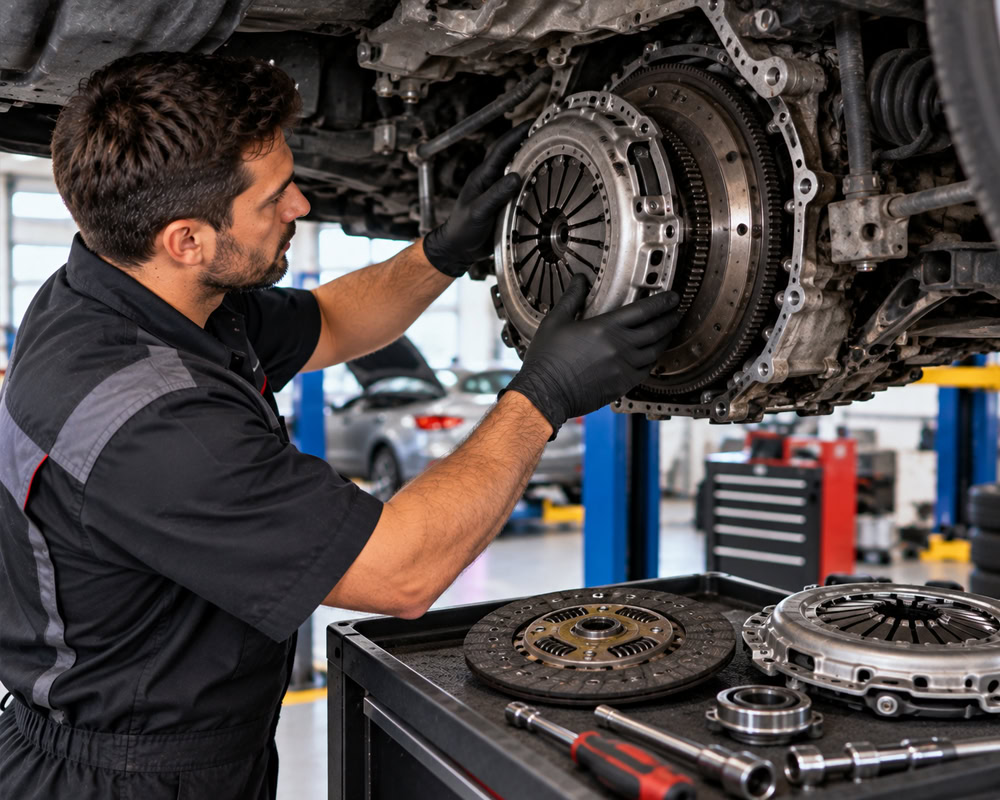
The flywheel is the surface the clutch plate grips. A slipping clutch generates enough heat to score, glaze, crack or warp it, and bolting a new clutch onto a damaged flywheel gives you judder and early failure. A solid flywheel can usually be machined flat, which is cheap. A dual mass flywheel, fitted to most modern diesels and many European cars, cannot be machined and has internal springs and bearings that wear out on their own.
While the gearbox is out we also check the spigot bearing, the clutch fork and pivot, the rear main seal and the gearbox input shaft seal. Any of those failing afterwards means pulling the gearbox again, and the labour is the expensive part.
The repair
What the job involves
The gearbox comes away from the engine, which on some cars means removing driveshafts, subframes or exhaust sections. The old clutch and flywheel come off, the flywheel is inspected and machined or replaced, then the new kit and thrust bearing go on with the clutch centred properly.
Hydraulics get bled or replaced as needed, pedal free play is set, and the car gets road tested. Most clutches want a few hundred kilometres of gentle bedding in.
Common questions
Frequently asked questions
How long does a clutch last?
Anywhere from 40,000km to well past 200,000km. City driving, towing and riding the pedal shorten it. Highway driving extends it.
Why is my clutch pedal so heavy?
A worn pressure plate, a seized or stretched cable, a dry pivot, or a hydraulic fault. Worth inspecting rather than living with.
Do I have to replace the flywheel?
Not always. A solid flywheel can usually be machined. A dual mass flywheel cannot be machined and is replaced if it fails inspection.
What is a dual mass flywheel and why is it expensive?
It has internal springs and bearings that damp driveline vibration, common on diesels and European cars. It wears out independently of the clutch and costs considerably more than a solid one.
How long does a clutch replacement take?
Usually a day for most cars. Some 4WDs, vans and transverse European models take longer.
Do you do clutches on utes and 4WDs that tow?
Yes, and if you tow regularly we can talk about a heavier duty kit.
Will a new clutch fix my grinding gears?
If the clutch was dragging, yes. If a synchro is worn, no. See gearbox repairs for that.
Is my problem the clutch or the transmission?
If the pedal and take-off feel wrong, it is usually the clutch. If shift quality or engagement is wrong, it points more at the transmission.
Get a full clutch quote
The whole job quoted
up front, no surprises.
Monday to Friday 8am to 5pm, Saturday 8am to 3pm. After-hours key drop available. All major cards and cash.