Engine and cooling repairs
Engine Diagnostics in Moorooka
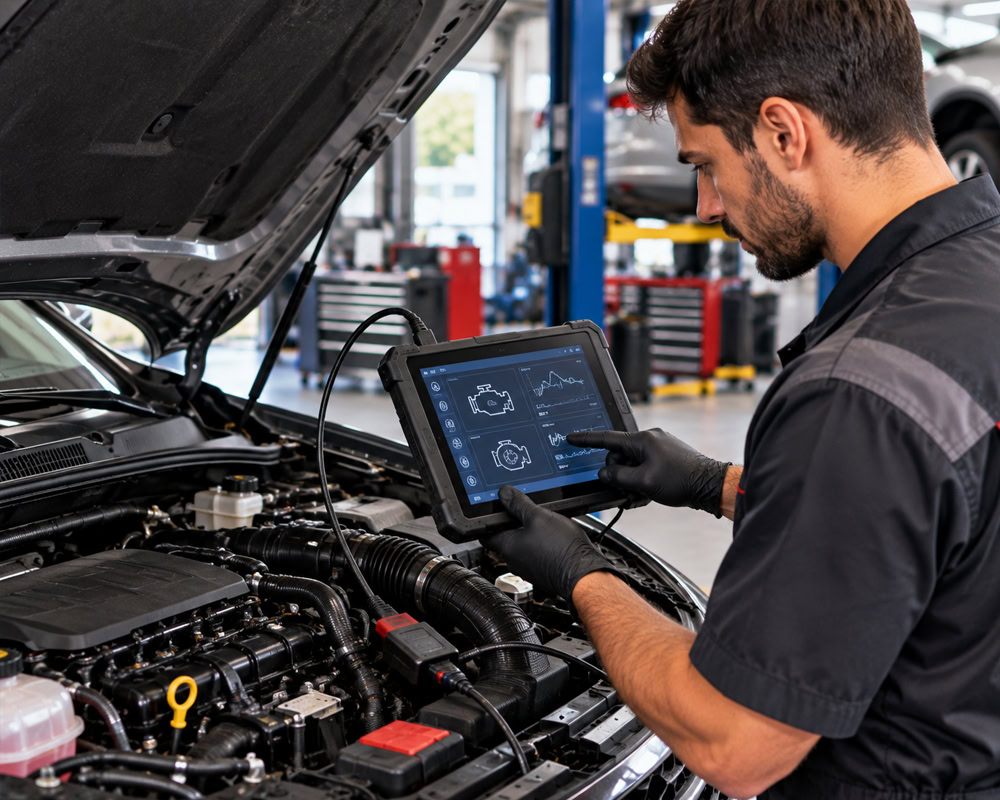
A fault code is not a diagnosis. The code tells you which circuit the engine computer was unhappy with, and there are often half a dozen things that can trigger it. We read the codes, then test the actual components, wiring and live data to work out which one has failed, so you pay for the part that is broken instead of the three that were not.
The real problem with free code reads
Reading a code versus diagnosing a fault
Anybody can plug a scanner in. The tool costs less than a tank of fuel and half the auto parts chains will do it for free at the counter. What comes back is a code like P0171, and what people hear is "your oxygen sensor is faulty".
P0171 means the engine is running lean on bank one. That is the computer describing a symptom, not naming a part. The list of things that cause it includes a torn intake boot, a vacuum leak at a gasket, a dirty air flow meter, a weak fuel pump, a partly blocked fuel filter, a leaking injector seal, or an exhaust leak upstream of the sensor. The oxygen sensor is on that list too, but it is usually the messenger rather than the culprit.
Replace the sensor and the light comes back a week later. That is not bad luck. That is what happens when a code gets treated as an answer.
The full process
What we actually do
Full system scan
Every module, not just the engine. Stored codes, pending codes, freeze frame data showing the conditions when the fault occurred, and the readiness monitors.
Live data
Fuel trims, sensor voltages, air flow readings against expected values, misfire counters per cylinder, injector timing. This is where most faults reveal themselves.
Physical testing
Smoke testing for vacuum and intake leaks, compression and cylinder leak-down where a mechanical fault is suspected, back-probing connectors to check what the wire is doing rather than what the computer thinks.
Road test
Some faults only appear warm, under load, or at a particular throttle position. A scan tool in a stationary car will never see them.
We then tell you what failed, why, and what it costs to fix.
What the warnings mean
Common warning lights
Solid check engine light
The computer has logged a fault. The car is generally safe to drive to the workshop but something is not operating as designed, and emissions faults get worse and more expensive if you sit on them.
Flashing check engine light
Stop driving it. A flashing light almost always means an active misfire severe enough to dump raw fuel into the exhaust, which can destroy a catalytic converter in a very short drive.
Temperature warning
Pull over safely and shut it down. Do not open the radiator cap.
Oil pressure light
Not an oil level reminder. Stop immediately. Continuing to drive with genuine low oil pressure will destroy the bearings.
Codes we see regularly
Common fault codes
- P0300 / P0301–P0306 Random or cylinder-specific misfire. Could be coils, plugs, injectors, compression, or a vacuum leak. The cylinder number tells you where to look, not what to replace.
- P0420 Catalyst efficiency below threshold. Often blamed on the converter when the real cause is a lazy rear oxygen sensor, an exhaust leak, or an engine that has been running rich for months.
- P0128 Coolant thermostat below regulating temperature. The engine is not warming up properly, usually a thermostat stuck open. Cheap fix, real fuel cost if ignored.
- P0011 and similar Camshaft timing over-advanced. Frequently an oil condition problem or a blocked variable valve timing solenoid screen rather than a failed actuator.
No warning light
When there is no light at all
Plenty of real faults never trigger a light. A rough idle at the lights, a hesitation when you pull out, hard starting on a cold morning, a whine that changes with revs, fuel economy that has drifted from 8L/100km to 11 without you noticing exactly when.
These are the jobs that reward experience over equipment. A scan tool will show you fuel trims running at plus 22 percent, but somebody still has to know that means an unmetered air leak and go and find it.
At the end you get a plain explanation of what is wrong, what it costs to repair, and what happens if you leave it. If the fault is something you can fix yourself for twenty dollars, we will tell you that too.
Common questions
Frequently asked questions
Can I keep driving with the check engine light on?
If it is steady and the car drives normally, usually yes, but get it looked at soon. If it is flashing, stop driving and call us.
Why did the free code read at the parts shop not fix it?
Because it gave you a code, not a diagnosis. The code names a circuit or a symptom. Working out which component in that circuit has failed takes testing.
How much is a diagnostic?
[CONFIRM: typical price range for engine diagnostic charge] Charged for the time it takes to find the fault properly.
How long does it take?
Straightforward faults are often found within an hour. Intermittent electrical faults can take considerably longer, and we will call you before running past what was agreed.
The light went out by itself. Am I fine?
Not necessarily. The code stays stored. If the condition cleared, it may well come back under the same driving conditions that caused it.
Will a diagnostic fix the problem?
No. A diagnostic identifies the problem. The repair is quoted separately and you approve it.
Can you diagnose a car that will not start?
Yes, though it needs to get to us. That is a different test path to a running fault.
Do you diagnose diesel engines?
Yes, including common rail injection faults, DPF issues and turbo problems.
My car is a hybrid. Can you scan it?
Yes, we work on hybrid and electric vehicles.
Do you charge for the diagnostic if I get the repair done here?
[CONFIRM: whether diagnostic fee is credited against the repair]
Can you clear the codes so I can pass a safety certificate?
Clearing a code without fixing the fault just hides it until it logs again. We would rather find the cause.
Book an engine diagnostic
Find the real fault.
Quote before we start.
Monday to Friday 8am to 5pm, Saturday 8am to 3pm. After-hours key drop available. All major cards and cash.