Vehicle inspections
Pre-Purchase Car Inspections in Brisbane
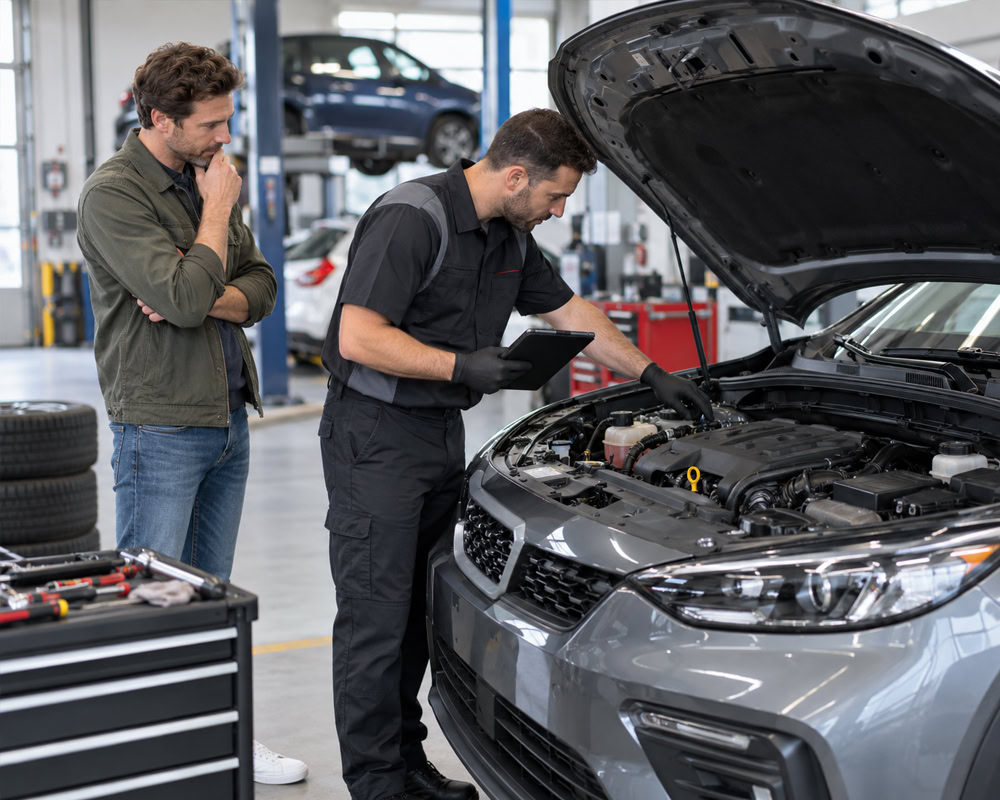
A pre-purchase inspection is a full mechanical and structural check of a used car before you buy it, carried out by someone with no stake in the sale going through. We do them at our Moorooka workshop or at the seller's address anywhere across Brisbane, and you get a written report covering condition, faults and what the car is going to need. The inspection costs a fraction of what buying somebody else's problem costs.
Before you pay
Why it matters more than the test drive
A test drive tells you whether you like the car. It does not tell you the timing belt is overdue, or that the front end has been repaired and resprayed after a hit.
Private sellers are not always hiding things. Plenty genuinely do not know what is wrong with their own car. Either way the money is yours once you hand it over, and there is no cooling-off period on a private used car sale in Queensland.
Do these first
Before you book anyone
Some of the most important checks take ten minutes at your kitchen table. Do them before you pay anyone.
- Run a PPSR check. The Personal Property Securities Register tells you whether money is still owing on the vehicle and whether it has been recorded as written off or stolen.
- Check the registration. Confirm the rego is current and that the plate matches the vehicle.
- Ask for service history. Gaps are not fatal, but a car with no history at all should be priced accordingly.
- Match the VIN. The VIN on the compliance plate should match the registration papers. A mismatch is a hard stop. Walk away.
The inspection checklist
What we check
This is the actual list our technicians work through.
Body, panels and paint
Panel gaps down both sides of the car and across the front and rear. Uneven gaps suggest panels have been off, or that the car has been pushed out of shape. Paint gets checked for colour mismatch between adjacent panels, overspray on rubbers and trim, and texture that does not match factory finish.
Rust
Surface rust on a bracket is one thing. Rust in the sills, floor pan, strut towers, subframes or around the windscreen aperture is another thing entirely. We look underneath, inside the wheel arches, and where rust starts before it is visible from outside.
Chassis and structure
The car goes on the hoist and we check the chassis rails, mounting points, seam sealer and underbody for signs of straightening, welding, crush damage or repair. Structural repair work makes a car worth materially less.
Engine condition and leaks
Compression and general mechanical condition, oil leaks from the sump, rocker cover, rear main and timing cover, coolant leaks, and any residue that points to a head gasket problem. Belts, hoses and mounts get checked with it.
Cold start behaviour
This is why we ask sellers not to warm the car up before we arrive. A cold start reveals worn injectors, glow plugs on a diesel, rattling timing chains, and smoke that clears once the engine is warm and takes the evidence with it.
Fluid condition
Engine oil level and condition, coolant colour and strength, brake fluid, transmission fluid, and power steering fluid where fitted. Burnt-smelling transmission fluid or milky oil points at repairs that cost real money.
Transmission and clutch
Automatics get checked for shift quality, flare between gears, harsh engagement and slipping under load. Manuals get checked for clutch bite point, slip under acceleration in a high gear, dragging, crunching into gear and worn synchros.
Brakes
Pad thickness, rotor condition and wear lip, calipers and slide pins, hoses and lines, handbrake operation, and pedal feel. Pull under braking or a pulsing pedal usually means warped rotors.
Tyres
Tread depth, age, brand mismatch across an axle and general condition. Uneven wear is the useful part — wear on the inside edge usually means the alignment is out or a suspension component is worn. Tyres tell you about the car, not just about the tyres.
Steering and suspension
Play in the steering rack and column, tie rod ends, ball joints, control arm bushes, shock absorbers and struts, springs, and wheel bearings. We check ride height side to side and listen for noises that only turn up over a bump or on full lock.
Electrics and warning lights
Lights, indicators, horn, wipers, windows, central locking, air conditioning, instrument cluster and every warning light on the dash. We check that none of those lights have been disabled.
Full diagnostic scan
We scan every module the car has, not just the engine. That pulls stored fault codes and pending codes — the ones that have not yet triggered a dash light. Pending codes are how you find the fault a seller cleared last week.
Road test
A proper drive at suburban and highway speed. Engine performance under load, gear changes, braking from speed, steering feel, tracking, noises, vibration, and how the car behaves over bumps and around corners. Plenty of faults only appear at 90km/h.
After the inspection
What you get
A written report listing what we found, sorted by how urgent it is. Where a repair is needed we tell you roughly what it costs, so you can put a number on it.
Most buyers use the report one of two ways. They walk away from a car that was going to cost them thousands, or they go back to the seller and negotiate the price down.
We come to the car
We can inspect at the seller's address
You usually cannot drive a stranger's car to a workshop, which is exactly why mobile pre-purchase inspections exist. We inspect the vehicle where it is parked across Brisbane, Logan, Ipswich, Moreton Bay and Redlands.
Mobile pre-purchase inspectionsCommon questions
Frequently asked questions
How long does it take?
Longer than a safety certificate, because of the diagnostic scan and the road test.
Is a pre-purchase inspection the same as a roadworthy?
No. A safety certificate confirms the car met a minimum legal safety standard on the day. A pre-purchase inspection covers condition, wear and upcoming repair costs.
Can you inspect a car at a dealership?
Yes. Most dealers allow an independent inspection, and one who refuses has told you something useful.
Do you do a PPSR check for me?
We tell you what to look for. Run it yourself before you book, because a bad PPSR result means there is no point paying for an inspection.
What if the seller will not let you scan the car?
That is a serious warning sign. The scan is quick and does not harm anything.
Can you inspect European or diesel vehicles?
Yes. All makes and models, including European, diesel, 4WD, hybrid and EV.
What if the car turns out to be badly worn?
Nothing passes or fails a pre-purchase inspection. You get the facts, including any evidence of accident repair, and you decide.
Can you inspect on a Saturday?
Yes, Saturday 8am to 3pm. Private sales often happen on weekends, so book ahead.
You are welcome to be present?
Yes. Plenty of buyers prefer to hear it while the car is on the hoist.
Book before you buy
Get the car inspected
before you pay.
Monday to Friday 8am to 5pm, Saturday 8am to 3pm. After-hours key drop available. All major cards and cash.