
Brakes, tyres and suspension
Brake Repairs in Moorooka, Brisbane
If your brakes squeal, grind, pulse or feel soft underfoot, bring the car to Moorooka and we will tell you exactly what is worn and by how much. We measure pad and rotor thickness rather than guessing, and we show you the parts off the car before anything gets replaced.
Warning signs
What the noise or feel is telling you
Brakes give you plenty of warning. Most people just are not sure what the warning means.
Squealing
A high pitched squeal that comes and goes, usually worse in the morning or after rain, is most often the wear indicator. That is a small metal tab built into the pad that starts touching the rotor when the friction material gets low. It is designed to annoy you into booking. You have some life left, but not a lot.
Grinding
That is the steel backing plate of the pad running directly on the rotor face. The pad material is gone, and every stop from here is cutting a groove into a rotor that would probably have been machinable a fortnight ago. Grinding brakes are not a next-week job.
Soft or spongy pedal
A pedal that goes further than it used to, or feels springy rather than firm, points at the hydraulic side. Air in the lines, moisture in old fluid, a failing master cylinder, or a hose that balloons under pressure. If the pedal slowly sinks to the floor while you hold pressure, stop driving the car.
Pulsing under braking
A pedal that pushes back at you and a steering wheel that shakes only when you brake means the rotor is not running true. Either it has warped from heat or it has worn unevenly, often because a slide pin has seized and the pad is dragging on one side.
The inspection
What our brake inspection covers
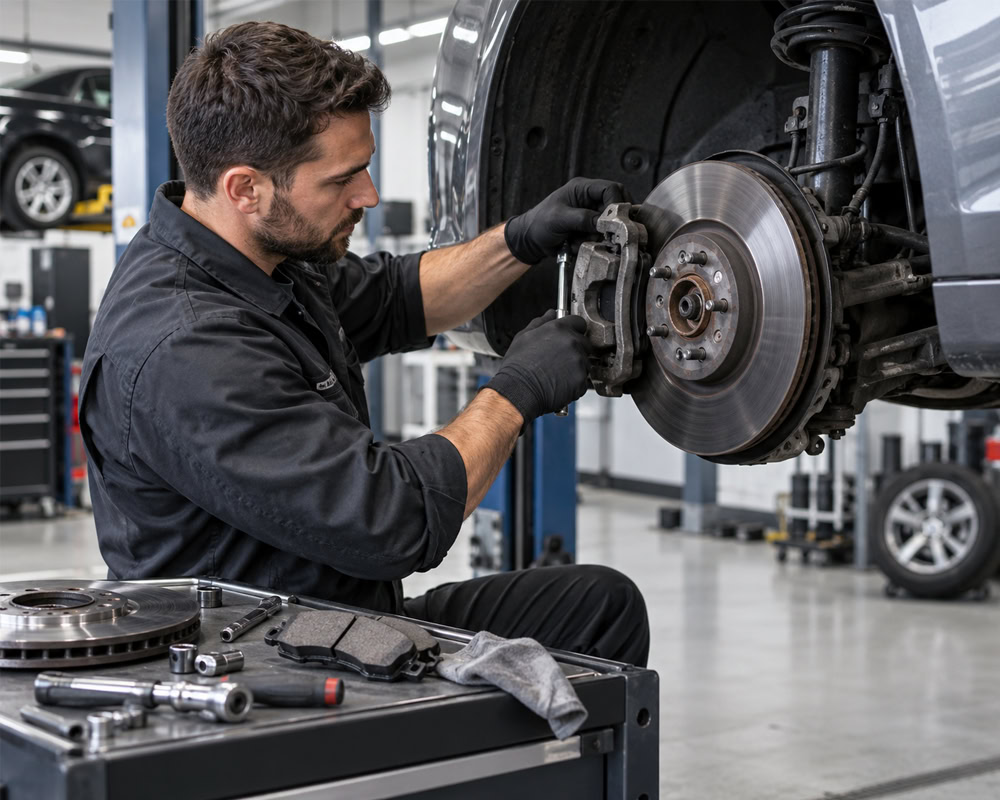
The car goes on a hoist and the wheels come off. Nothing useful can be judged through a wheel gap. We measure remaining pad material on all four corners and rotor thickness against the minimum stamped on the rotor. We check the rotor faces for scoring, lipping and heat cracking, look for uneven pad wear that points at a sticking caliper, inspect hoses and hard lines, check fluid condition and test the handbrake.
Then you get the numbers. If your fronts are at 4mm you get told they are at 4mm and roughly what that gives you.
Honest advice
Machining versus replacing rotors
People get quoted very different things by different workshops here, so here is the honest version. A rotor can be machined when it is thick enough that removing the damaged surface still leaves it above the manufacturer's minimum thickness. Machining trues up the face and fixes pulsation caused by uneven deposits or mild warping. It is the cheaper outcome and we will take it where the measurement allows.
A rotor must be replaced when it is already at or near minimum, when it is cracked, or when it is so deeply grooved that cutting it below minimum is the only way to clean it up. A rotor under minimum thickness cannot shed heat properly. It will fade under repeated braking and it can crack.
Brake fluid
Why brake fluid needs changing
Brake fluid is hygroscopic, meaning it pulls moisture out of the air over time. Water lowers the boiling point, and fluid that boils turns to vapour, which compresses. That is when the pedal goes to the floor on a long descent.
Most manufacturers call for a change every two years regardless of kilometres. In Brisbane humidity it is not something to stretch out.
Safety certificates
Brakes and your safety certificate
Brakes are one of the most common fail items on a safety certificate inspection. Pads worn past the indicator, rotors under minimum thickness, a handbrake that will not hold on a slope, weeping hoses and low fluid will all stop the certificate being issued.
We can inspect, repair and certify in the same visit.
Pricing
What brake repairs cost
Brake repair costs vary with the vehicle and with what the measurements show, so we quote after the inspection rather than over the phone. [CONFIRM: typical price range]
You get the findings, then a quote, then a decision. Nothing gets replaced without your approval, and every part carries its supplier or manufacturer warranty.
Common questions
Frequently asked questions
Why do my brakes squeal in the morning and then stop?
A light surface rust film builds on the rotors overnight and gets scrubbed off in the first few stops. That is normal. A squeal that continues once the car is warm is the wear indicator.
Is it safe to drive with grinding brakes?
No. Grinding means the friction material is gone and you are braking on metal. Stopping distances are longer and the rotors are being destroyed as you drive.
Can rotors always be machined?
No. They can only be machined if they will still be above the manufacturer's minimum thickness after the cut. Below that they have to be replaced.
Why does my steering wheel shake when I brake?
Uneven or warped rotors. If the shake is there at speed without braking, look at wheel balance instead.
How often should brake fluid be changed?
Most makers say every two years. Fluid absorbs moisture, and moisture lowers the boiling point.
Do I have to replace pads and rotors together?
Not always. If the rotors measure well and the surface is good, pads alone are fine. New pads on a badly grooved rotor will not bed properly, so sometimes both is the right call.
My handbrake will not hold on a hill. Is that a big job?
Often it is a cable adjustment or worn shoes in the drum section of a rear disc. It is a safety certificate fail either way.
How long does a brake repair take?
Most front brake jobs are done the same day. Book ahead so the car goes straight on a hoist.
Book a brake inspection
Numbers first.
Then a decision.
Monday to Friday 8am to 5pm, Saturday 8am to 3pm. After-hours key drop available. All major cards and cash.