
Engine and cooling
Cooling System Repairs in Brisbane
If your temperature gauge is climbing, stop driving before you get to the workshop. Overheating for even a couple of minutes can warp a cylinder head, and that turns a cheap repair into a very expensive one. We pressure test the whole system at Moorooka and repair thermostats, water pumps, hoses, fans, radiators and expansion tanks, then work out why it failed in the first place.
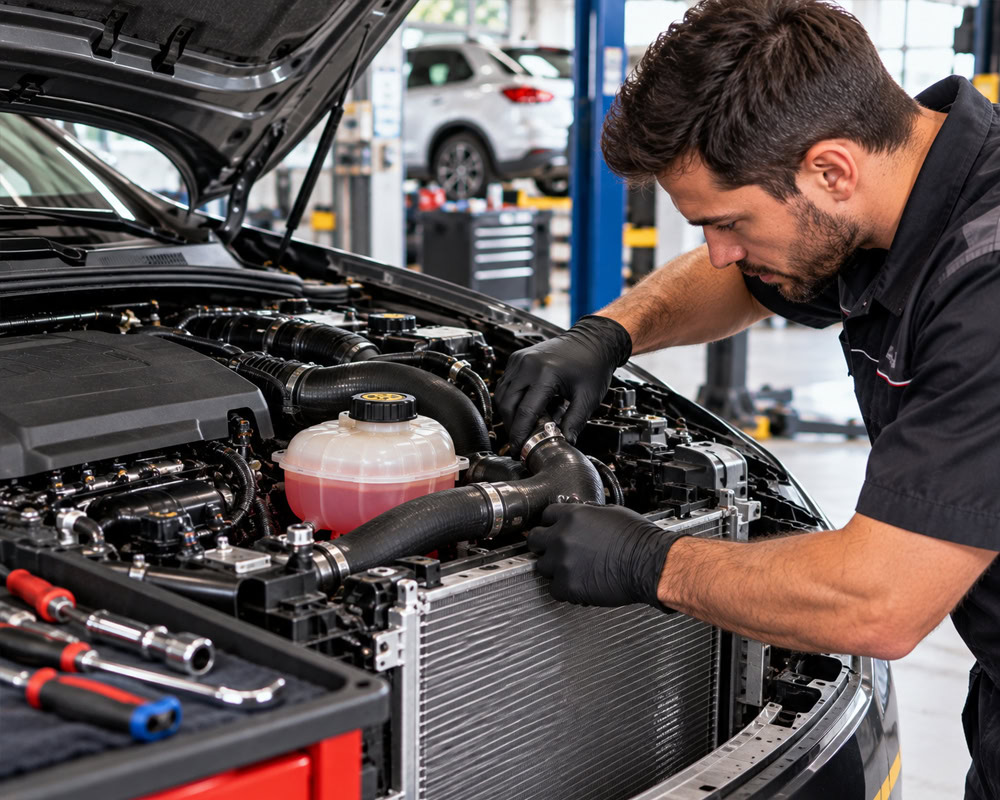
If the gauge climbs
What to do the moment the gauge climbs
- Switch the air conditioning off — it removes a large heat load immediately.
- Turn the cabin heater on full with the fan up. It feels awful and it genuinely pulls heat out of the engine through the heater core.
- If you are stationary in traffic, put it in neutral and lift the idle slightly to get the water pump and fan moving faster.
- Pull over somewhere safe and turn the engine off.
- Leave the bonnet closed for a minute, then open it to let heat escape.
- Do not touch the radiator cap or the expansion tank cap while it is hot. The system is pressurised well above atmospheric, and releasing that pressure sends boiling coolant straight up at you.
- Wait until the top hose is cool enough to hold before you check anything.
- Call 0402 723 464 rather than trying to nurse it home.
The temptation is always to keep driving because you are nearly there. Nearly there is how head gaskets die.
Local conditions
Why Brisbane is the hard test
Cooling systems are sized for the worst case, and around here the worst case is a summer afternoon on Ipswich Road with the traffic not moving. At a standstill there is no ram air through the radiator, so everything depends on the fan. Ambient air is already in the thirties, which cuts the temperature difference the radiator has to work with. The air conditioning condenser sits in front of the radiator adding heat to the airflow, and it is running flat out because it is 33 degrees.
A system that is even slightly compromised — a fan that only runs on high speed, a radiator half blocked, coolant that lost its inhibitors four years ago — will cope on the motorway and fail exactly there. That is why we take "it only does it in traffic" as a real symptom rather than a quirk.
Common failure points
The parts that fail
Thermostat
Stuck closed causes rapid overheating. Stuck open means the engine never reaches operating temperature, which shows up as poor heater output, worse economy and a P0128 code. Cheap part, big consequences either way.
Water pump
Bearings wear and seals leak. The warnings are a coolant drip from a weep hole, a whine or growl from the front of the engine, or coolant on the timing cover. On belt-driven pumps it goes in with the timing belt.
Hoses
Rubber hardens with heat and age. A hose that feels rock solid or spongy and soft when cold is on its way out, and they fail suddenly and completely rather than seeping first.
Thermo fans
Fan motors, relays and temperature sensors all fail. A car that overheats in traffic but is fine at speed is describing a fan fault until proven otherwise.
Heater core
Blocks up or leaks. A leaking core smells sweet inside the car, fogs the windscreen with an oily film, and leaves the passenger footwell damp.
Expansion tank
Plastic cracks with age, often along a seam where you cannot see it until the system is pressurised.
The right test first
Head gasket, or something simpler?
Every overheating job gets tested for combustion gases in the coolant before we start replacing parts. A block test takes minutes and it answers the question that decides everything else. If gases are present, you are looking at a head gasket, a cracked head or a cracked block. If they are not, the problem is in the cooling system itself and the repair is usually far cheaper.
Doing that test first is the difference between fixing your car and replacing parts on it.
The system is pressure tested cold, the cap is tested to its rating, the fan operation is checked with the engine at temperature, the coolant is inspected and tested, and the actual running temperature is measured rather than trusted to the dash gauge. Where a leak is hiding, UV dye finds it. Then you get a quote, and the work only starts once you have said yes.
Common questions
Frequently asked questions
Why does my car overheat in traffic but not on the highway?
Airflow. At speed the radiator gets plenty of air, at a standstill it depends entirely on the fan. Usually a fan fault or a partly blocked radiator.
Can I open the radiator cap to check the coolant?
Only when the engine is completely cold. Opening a hot system releases pressurised boiling coolant and causes serious burns.
How long can I drive an overheating car?
Treat the answer as zero. Head damage can happen within a couple of minutes of genuine overheating.
My gauge is normal but the car is losing coolant. Why?
There is a leak somewhere, possibly a small one that only opens under pressure, or coolant is going into a cylinder. Both need testing.
How much is a thermostat replacement?
[CONFIRM: typical price range for this job] It depends heavily on where the thermostat sits, since some are accessible and some are buried.
Is overheating always the head gasket?
No, and assuming so costs people money. Fans, thermostats, radiators and hoses are far more common causes.
Should I use water or coolant?
Coolant, always, of the correct type for your engine. Water alone boils sooner and provides no corrosion protection.
My heater has stopped working. Is that related?
Often yes. Low coolant, a blocked heater core or a thermostat stuck open all cause it.
How often should the cooling system be checked?
At every service. Hoses, caps and coolant condition take a couple of minutes to check and save thousands.
Do you work on diesel and 4WD cooling systems?
Yes, including vehicles that tow and run heavier cooling loads.
If the gauge is climbing
Pull over and call us.
Do not drive it here.
Monday to Friday 8am to 5pm, Saturday 8am to 3pm. After-hours key drop available. All major cards and cash.